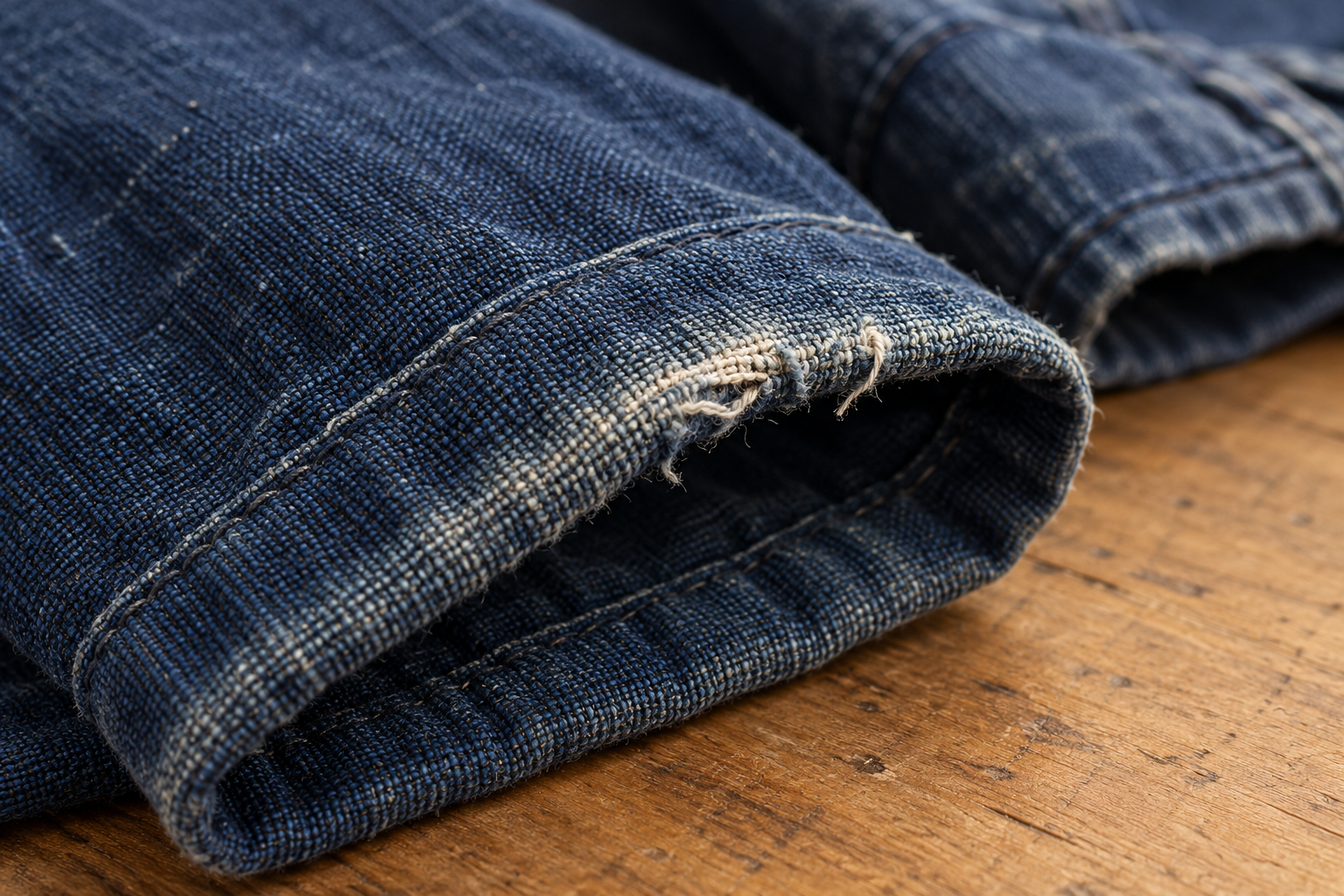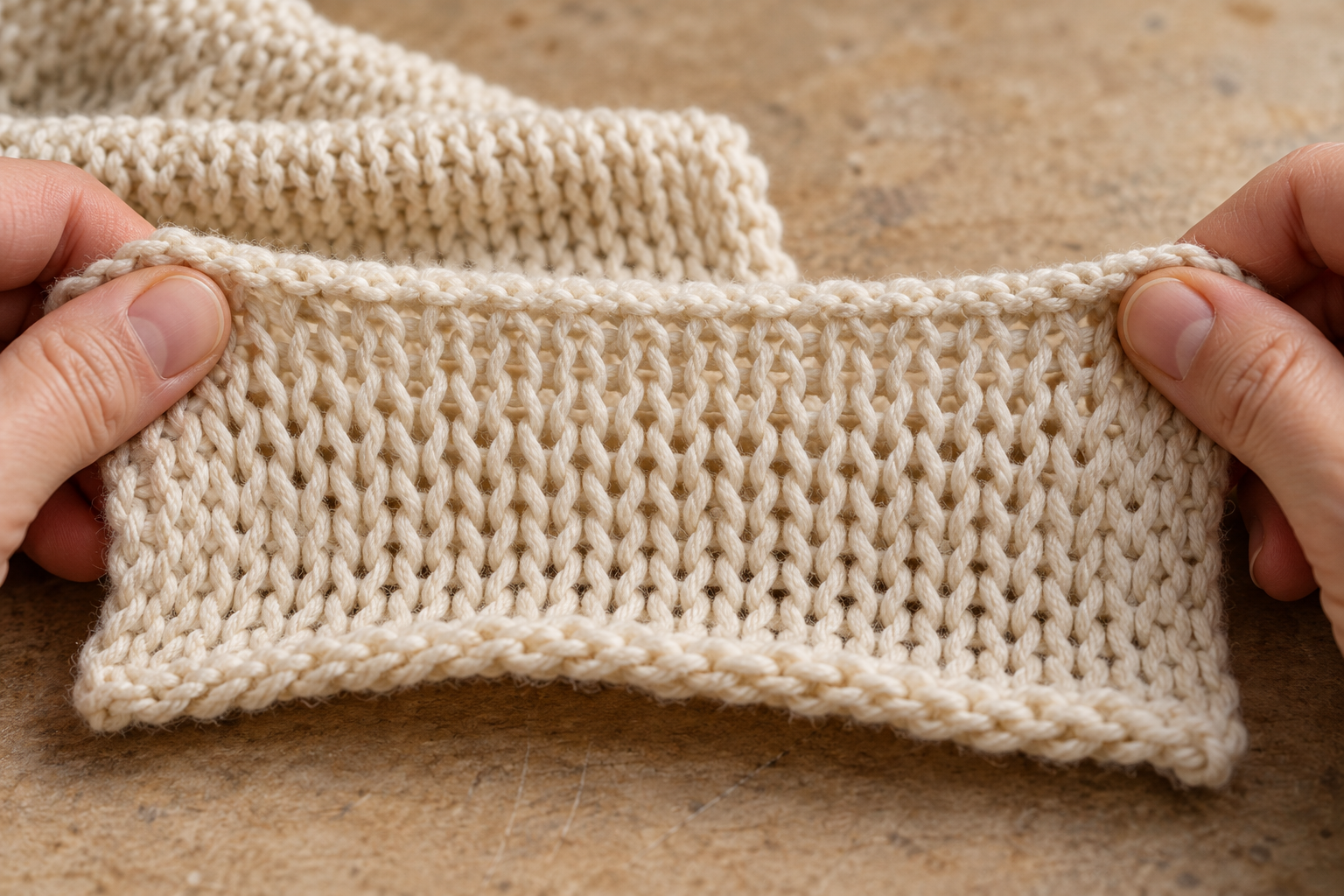
Pick up a piece of woven cloth and find an edge that was never cut. It may be firm, narrow, and a little different in texture from the rest of the fabric. Now imagine slicing across the cloth with scissors. Both lines are edges, but they have different histories. The first was made as the cloth grew on the loom; the second exposes the ends of threads that once ran farther. That difference explains why a woven side edge can hold together without a row of stitches sewn over it.
The name for the lengthwise, loom-made edge is selvedge, also spelled selvage. The warp threads run in that same direction, held under tension on the loom. The weft travels across them. The National Park Service's weaving guide describes the essential sequence: raise a selection of warp threads to make a shed, pass the weft through it, and beat that weft into the growing cloth. Its glossary places the selvedge parallel to the warp. This orientation matters. The short end left when a length of fabric is cut from the loom is a different problem from the long side made during weaving.
A thread that comes back
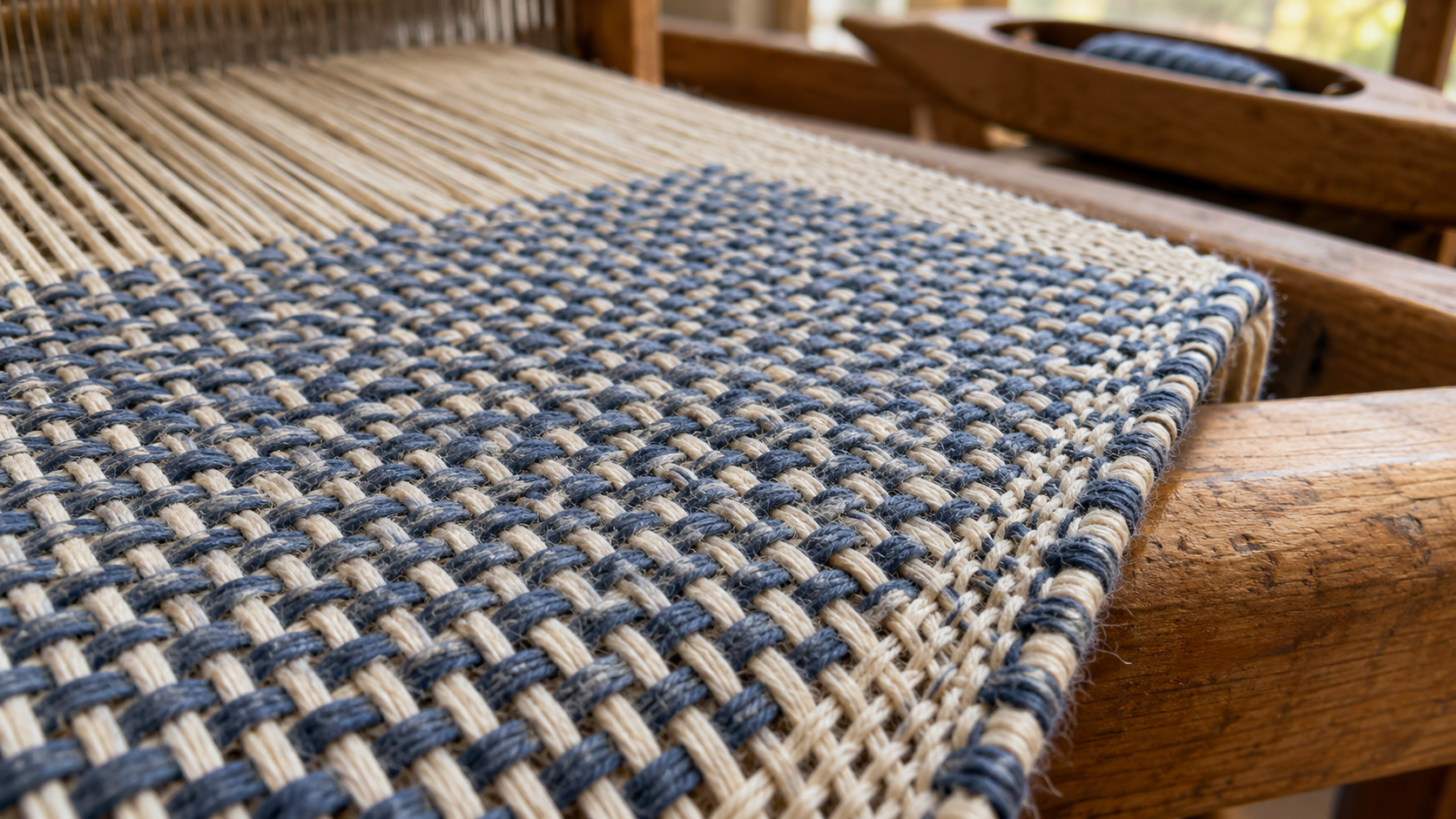
On a handloom using a shuttle, a single length of weft can cross the shed, turn at the outer edge, and cross back through the next shed. Each crossing is a pick. In plain weave, the warp threads that were up for one pick are down for the next, so the weft alternates over and under its neighbors. At the side, the returning weft turns around the outer warp instead of ending as a loose tail. The edge is therefore part of the cloth's interlacing, not a later binding. The ILO's 1983 weaving manual describes this shuttle-made edge as a true selvedge and contrasts it with the edge constructions needed when each pick is cut. A Schacht handloom manual shows the basic action at a smaller scale: carry the shuttle through one shed, change the shed, and send it back.
That account gives the edge a sound reason to stay intact, but it does not guarantee a neat line. The weft must travel farther than a ruler laid flat across the warp. It bends above and below the warp threads, and it needs enough length to make those bends. Pull the shuttle's thread tight against the side before beating it into place and the edge warps are drawn inward. Repeat that small pull pick after pick and the fabric narrows. Leave too much thread at the turn and loops project from the side. The edge records a sequence of tiny decisions about length and tension.
A 2008 Handwoven teaching column makes this relationship practical rather than mysterious. It links smooth selvedges to the angle at which the weft enters the shed, the pull against the outer warp, evenness of warp tension, and whether the bobbin feeds freely. A weft laid at an angle has a little reserve to take up as it bends through the cloth. Schacht's loom instructions likewise tell the weaver to leave that angle to avoid draw-in. Neither source offers a magic angle for every yarn and weave. The useful principle is to give the weft enough length for its actual path without leaving slack hanging at the side.
The outer warp can also be treated deliberately. An edge may use stronger or more closely spaced warp threads, as the National Park Service glossary notes; that is one way to make the margin less inclined to curl or fray. In some weave structures, the weft does not naturally pass around an outer thread on every pick. A floating selvedge—an additional edge warp managed so the weft passes around it—can give the shuttle a consistent turning point. The Handwoven column presents it as a tool for particular structures, not as a repair every fabric requires. What looks like a simple border can reflect a choice of threading, yarn, and handling made before the finished cloth existed.
When there is no return trip
The shuttle's out-and-back path is only one way to make a usable edge. Many industrial looms insert a weft from a package at the side of the machine without carrying the same shuttle back through the next shed. If the inserted length is cut, its end must be secured by some other construction. The old shuttle edge and a modern cut-pick edge can both be called selvedges in ordinary textile use, but their thread paths are not identical. The ILO manual identifies tucked and leno edges among the solutions used on shuttleless looms. Its preference for what it calls a “true” selvedge is a period judgment about appearance; the mechanical distinction is the useful part here.
One solution folds the loose weft end back into the next open shed. A 2001 tuck-in apparatus patent describes a mechanism that takes a cut end at a shuttleless loom's edge and inserts it back among the warp threads. The end gains a second, short course inside the cloth, where subsequent interlacing holds it. The patent documents one design, not a claim that every shuttleless loom uses the same nozzle or sequence. Look closely at a tucked edge and its extra thickness may tell you that a thread has doubled back, even though no shuttle made a continuous turn from one pick to the next.
Another solution recruits special edge threads to grip the inserted weft. In a leno edge, those threads cross around one another as the picks arrive, locking the weft near the side. A 2013 patent for a leno-selvedge forming apparatus sets out one such crossing sequence. The principle differs from tuck-in: the crossing edge yarns do the binding rather than a cut weft end folded back into the shed. Neither name by itself tells you how the entire fabric was woven or how durable a particular edge will be. Yarn, sett, finishing, and use still matter.
This is why “the weft turns around at the edge” is a good explanation for a shuttle-woven cloth and an incomplete definition of all woven cloth. The larger rule is that the loom must provide a way to keep a crosswise thread from simply slipping out at the side. It may give that thread a continuous return path, tuck its cut end into the cloth, or bind it with crossing edge yarns. The edge is a construction, not an invisible seal.
There is one final boundary to keep in mind. When the cloth comes off a handloom, its warp ends can still be loose. Schacht's instructions direct the weaver to knot groups of those ends after cutting the fabric free so the weft does not ravel from the end. A stable selvedge along the sides does not finish a transverse cut for you. If you cut away the selvedge itself, you create a new raw side whose exposed weft ends may need hemming or another finish.
The side edge is easiest to understand when you follow one thread rather than stare at the border as a line. A shuttle sends it out and brings it home; a different loom catches its cut end or locks it between crossing yarns. In each case, the weaver or machine must also leave the right amount of length for the path the thread actually takes. The margin holds because its threads have somewhere to go, and because they are neither strangled nor left loose along the way.
A thought worth keeping?