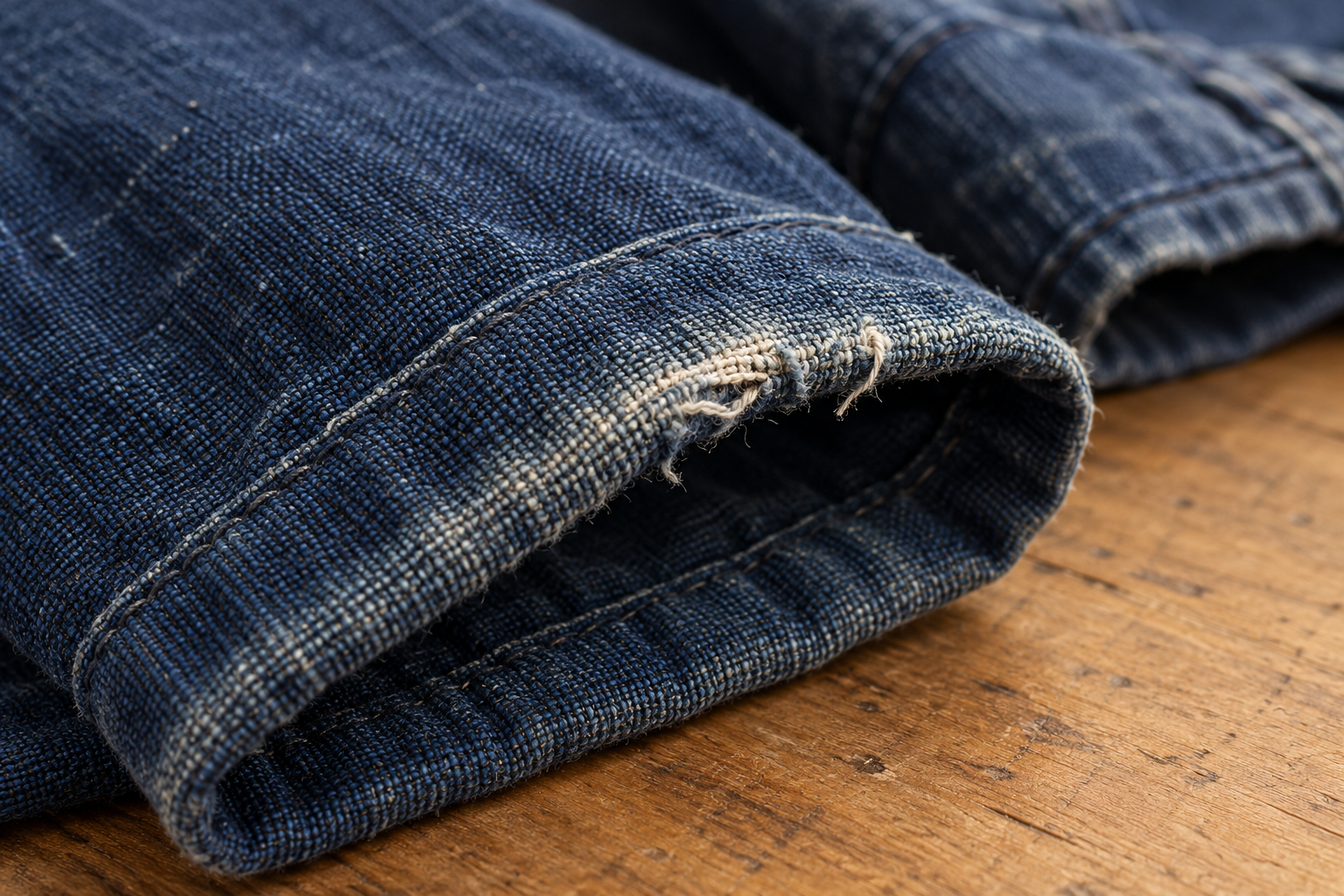
A trouser cuff can announce its age with a narrow pale line. The cloth above it still looks sound. Along the turned edge, individual threads begin to show; later, one breaks, and the line becomes a gap. It is tempting to call this simply a weak fabric. But the location is the clue. A fold gives the same small strip of cloth a different life from the broad, flat panel beside it.
At the outer ridge, the fabric bends around a tight curve. As a cuff moves, is pressed, and is washed, that curve can be made and released repeatedly. The ridge may also meet a shoe, another part of the garment, or the inside of a washing machine. Bending and rubbing can act together, but they are separate ways to damage a textile. A fold can lose strength from repeated flexing even without an abrasive surface; an exposed edge can be rubbed down even when it rarely changes shape. Understanding which is happening is more useful than assuming every pale crease means a hole is imminent.
What the bend asks of a yarn
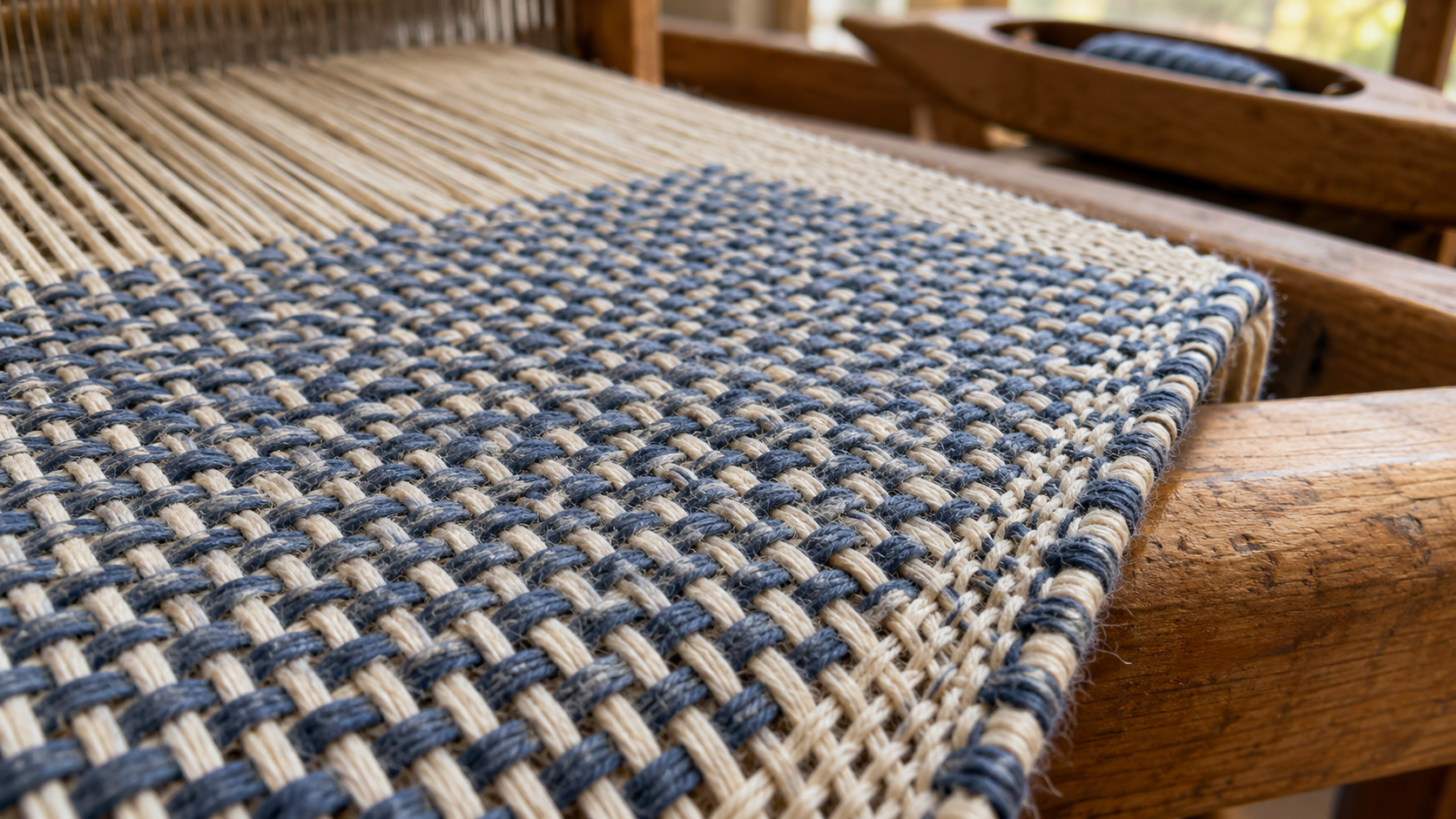
A woven cloth is not a uniform sheet. Each yarn rises and falls over others. When the cloth folds, some of those yarns bend more sharply than their neighbors, and the strained side changes as the fold is reversed. In a 1942 National Bureau of Standards experiment, Herbert Schiefer and Paul Boyland repeatedly folded narrow fabric strips under tension, then measured their remaining breaking strength. Photographs showed fiber failures in alternating yarns, in positions explained by the woven structure and the direction of the bend. The researchers were looking at specific tested fabrics, not establishing a countdown for a shirt cuff. Their central observation is still sharp: the geometry of a fold can select which yarns bear the strain.
The same study found that equal numbers of folds did not weaken all its fabrics equally. Acetate rayon, Fortisan and silk specimens lost much more strength under those test conditions than the viscose rayon, nylon and cotton specimens. The authors suggested that the ability of fibers to move within a yarn, and of yarns to move within a fabric, helped explain the differences. That is a structural explanation, not a permanent ranking of fiber names. Change the yarn, weave, finish, tension or bend radius and the result may change too. A close fold matters because it forces movement into a smaller space; what happens there depends on how freely the cloth's parts can accommodate it.
Wear at a fold has another source. Its ridge stands proud of the surrounding fabric. A contact that glides over the flat surface may press on this raised line, then rub it again the next time the garment moves. The marks can begin at the scale of a fiber: displaced ends, a flattened surface, or small breaks. In microscopy of durable-press cotton fabrics, Mary Rollins and colleagues found different damage patterns after dry and wet abrasion and after different cotton treatments. Untreated cotton under wet abrasion showed surface fibrillation; some cross-linked, crease-retaining samples failed through relatively brittle fiber breaks. Their experiments do not make every crease-retaining finish fragile. They show why a smooth-looking crease and a tough-wearing edge are different properties.
The second life of a cuff in the wash
The fold does not stop working when the garment is taken off. In a 1975 wear study, Mary Ann Morris and Harriet Prato followed durable-press polyester/cotton trousers and assessed edge abrasion after use and laundering. For those trousers, laundering accounted for approximately half the measured edge abrasion. Their laboratory cuffs also allowed them to test changes in wash and dry conditions. The finding is about that fabric, those constructed cuffs and their protocol; it is no license to divide every garment's wear evenly between wearing and washing.
The researchers later gave a detailed account of the wear trial and cuff tests. Twenty-seven men wore the polyester/cotton trousers through 60 wash-and-wear cycles. Differences among laundry treatments in that field trial were too small to count as significant, even though the comparison with trousers only laundered implicated laundering in substantial damage. In the separate laboratory work, sharper preserved creases tended to have greater edge abrasion, while a prolonged tumble dry caused significantly more abrasion in the tested cotton durable-press cuffs than the normal dry. Washing cuffs inside out reduced wear at some measured edges. A field garment, a simulated cuff and a broad rule for all laundry are three different things. The useful lesson is that an exposed fold continues to meet mechanical forces during care.
The contact material matters as much as the number of contacts. A 2019 comparison put cotton and polyester fabrics through three laboratory abrasion methods: rubbing against standard wool cloth, rubbing against abrasive paper, and contact with an abrasive slurry. Microscope images did not show one universal kind of “abrasion.” Cloth-on-cloth rubbing produced prominent repeated bending and tensile damage in the surface fibers. Coarse abrasive paper cut and disrupted fibers; fine particles in slurry wore their surfaces in another way. The authors cautioned that the methods cannot be interchanged as if a cycle in one machine were equivalent to a cycle in another. A cuff against a shoe and a cuff tumbling among clothes need not fail in the same way.
Even before a thread snaps, the fabric can change. In a 2025 optical-profilometry study, Małgorzata Matusiak and Gabriela Kosiuk measured the surfaces of five cotton woven constructions before and after 10,000 Martindale rubbing cycles. The highest parts of their surfaces tended to flatten or disappear, and the response varied with the weave. The study did not bend a cuff or follow a garment to a hole; it measured flat-sample surface geometry. It helps explain why a fold can look lighter, smoother or fuzzier before it is visibly torn. Appearance is evidence of a changed surface, but its exact look alone cannot tell how much strength remains.
Why two folds wear differently
Fiber content is one ingredient. Yarn construction and weave decide where fibers sit and how many are exposed. In a 2022 experiment on four cotton yarn constructions, Abdul Jabbar and colleagues made comparable woven fabrics from conventional and modified ring-spun yarns, then repeated abrasion and laundering. The modified-yarn fabrics released less fragmented fiber mass than the conventional one under their test conditions. Strength of yarns removed after testing decreased overall, though the decrease was not statistically significant for every construction. This connects fiber retention to the way fibers are held in yarn, without proving that one spinning system will outlast another in every cuff.
Weave can alter the result too. In a 2024 study of six flax-warp fabrics, Simona Vasile and colleagues compared plain, panama and twill weaves with flax or hemp weft yarns. Under their flat abrasion test, the panama specimens reached the study's thread-break endpoint earlier than the twill specimens; within each weave, the weft choice made little difference to that measure. Those are useful comparisons among six controlled constructions. They are not a rule that twill always resists wear best. The 2025 cotton surface study found a different pattern of surface change among its own weaves, and it measured shape rather than cycles to broken threads. Different cloth and different endpoints can answer different questions.
This is why a fold deserves inspection on its own terms. A line of color loss may be mostly dye removed from the exposed tops of yarns. Fuzz can mean fibers have been pulled or broken at the surface. A line where whole yarns have parted is a more serious loss of the cloth's structure. None of these marks reveals, by sight alone, exactly how many wear cycles remain. The position and progress of the mark give better clues: is it confined to the outer ridge, spreading beside a seam, or appearing wherever two surfaces rub?
A gentler bend, a protected edge, or less rubbing during care can reduce some forces, but no single instruction fits every textile. The durable-press cuff studies support specific choices for their tested fabrics; conservation guidance for an old, weakened textile would ask for a different kind of handling. The practical point is modest and useful: the fold is a place where the cloth repeatedly pays for changing direction. By the time a hole appears, the ridge may have spent many small losses of fiber and strength that the flat fabric beside it never had to bear.
A thought worth keeping?