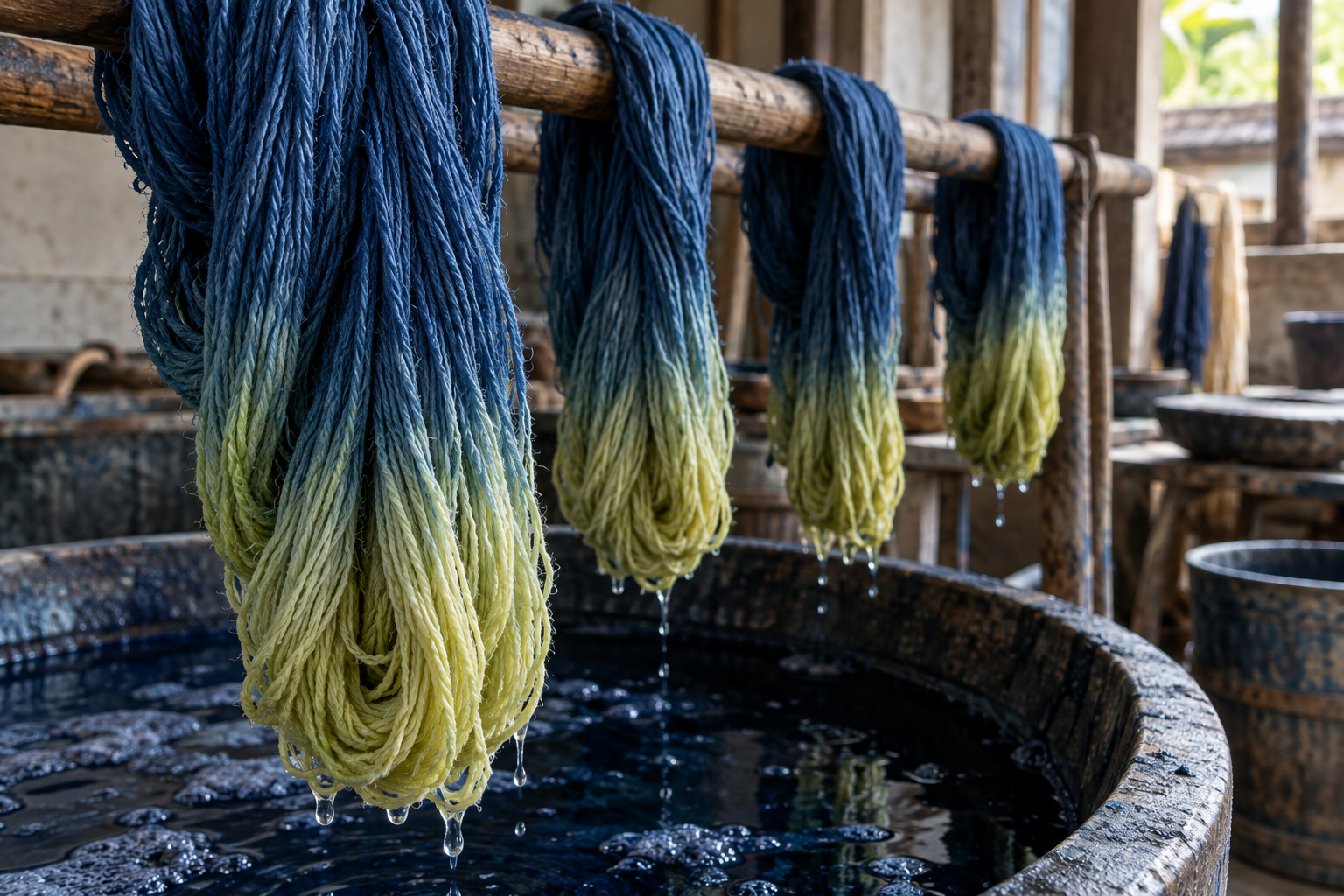
The blue in an indigo vat cannot simply be stirred into water and soaked into cloth. Blue indigo is scarcely soluble. To make it useful for dyeing, a dyer changes its chemistry: in a reducing vat, it becomes a soluble form called leuco-indigo. Fibre can meet that dissolved colour. Once the yarn is lifted into the air, oxygen turns the leuco form back into insoluble blue indigo, leaving the colour caught in and around the fibre. The familiar deep blue is therefore the end of a small chemical journey, not the colour of a liquid that merely dried on the thread. A 2018 experimental study of an alternative indigo process describes this reduction and oxidation sequence as the difficulty any indigo dyer must solve.
That sequence explains both indigo's appeal and one of its limits. In denim production, cotton yarn can pass through a reduced dye bath, be exposed to air, and repeat the journey until the desired shade builds. Each pass gives the soluble form another chance to reach the material; each exposure to air makes new insoluble blue. The same 2018 research paper describes repeated dips of cotton yarn with oxidation between them in a conventional mill process. Depth of shade is made in stages. It is tempting to imagine each stage as a fresh painted coat, but dye molecules do not all stop at the same depth, and a yarn contains many fibres as well as spaces between them.
A blue outside and a paler core
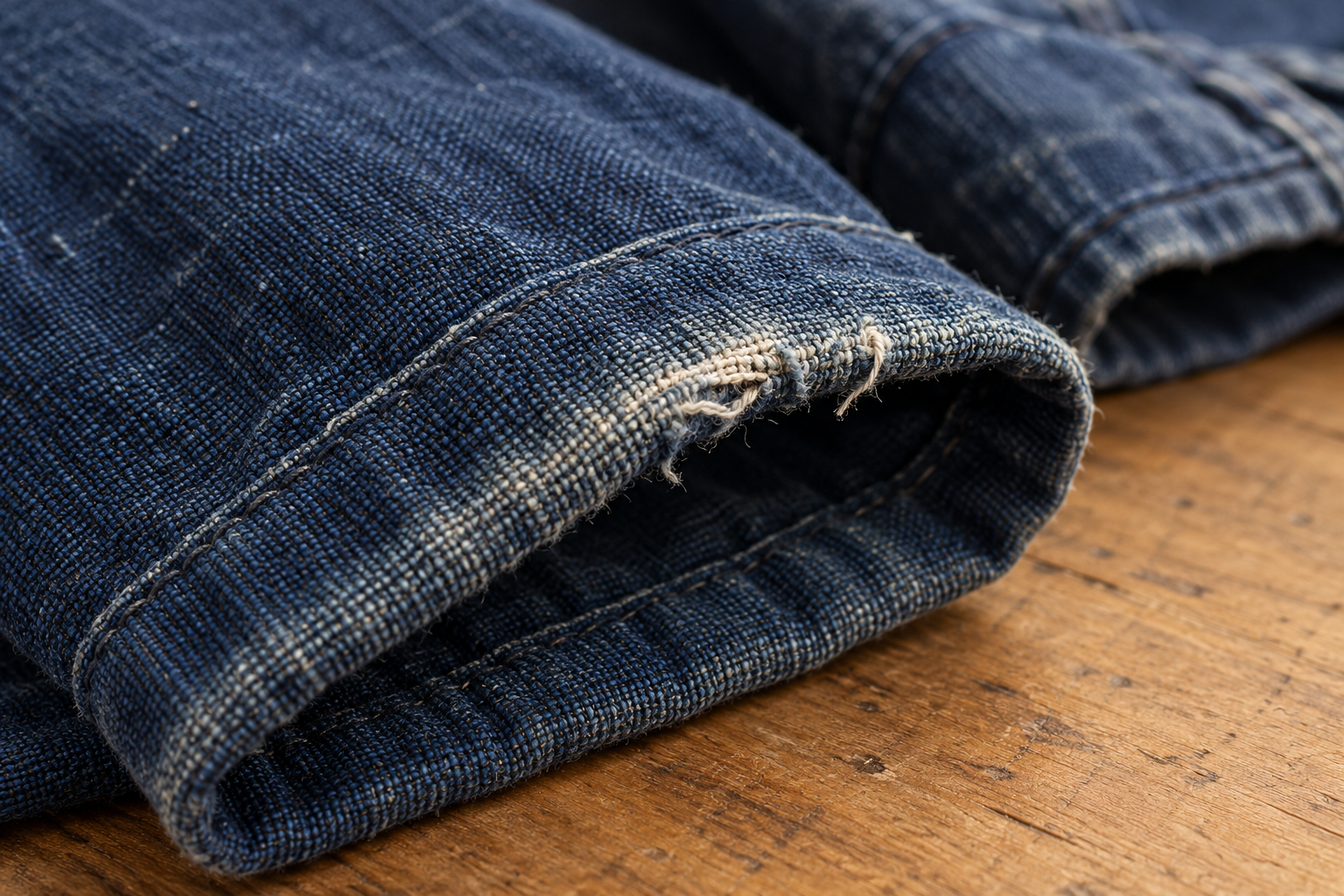
The cross section of a denim warp yarn is often described as ring dyed: the outer part is blue while the centre remains paler. That is a useful description of the yarn, especially when abrasion later exposes its lighter core. It is less useful as a universal statement about every cotton fibre. A soluble dye can diffuse into a fibre before it is oxidised; how far it gets depends on vat chemistry, immersion time, temperature, preparation of the cotton, and the way yarn or loose fibres are presented to the bath. The line between surface deposition and penetration is a variable result of a process.
In a 2019 experiment on indigo-dyed cotton fibre, Luo and colleagues compared a conventional water bath with a silicone-based non-aqueous method and measured colour and rubbing fastness. In their water-bath trials, early dyeing cycles permitted some reduced indigo to diffuse inward; later cycles increasingly placed colour near the outside. In their alternative system, dyeing temperature and the number of cycles affected both shade and how readily colour rubbed off. These are results for specified cotton fibres and baths, not a recipe for every dyer. They do, however, defeat the neat claim that indigo never penetrates a fibre. The more exact observation is that a process can favour a blue-rich exterior, and that colour held near the exterior is more exposed to friction.
Another cotton study at the University of Rhode Island compared ordinary cotton with cotton given a positive surface charge. The treated cotton took up more indigo under the tested conditions, yet showed worse wet and dry crocking—the transfer of colour under rubbing. Microscopic cross sections were part of the work. Greater uptake did not automatically mean better retention: where the colour sat mattered. A dark swatch can therefore conceal a different internal arrangement from another swatch of much the same blue.
This is why “surface dye” is both illuminating and incomplete. It names the vulnerable outer zone that helps give denim its characteristic wear, but a fibre is not a sealed cylinder and a yarn is not one fibre. The dissolved form can enter pores and spaces before oxidation traps blue material there. Cotton in a dense yarn, cotton spread as loose fibre, and cotton modified at its surface offer the vat different paths. A photograph of a blue thread tells us its visible shade; it does not reveal how far the leuco form travelled before the air changed it back.
A dip is a choice about time
The usual repeated dip is a response to indigo's limited affinity for cotton in a conventional vat. It gives a dyer a way to increase shade without assuming one long soak will yield the same distribution. The 2018 indigo study describes industrial cotton ropes moving through successive vats. The 2019 cotton-fibre experiment found that repeated cycles in its water method deepened colour up to a point, while too much colour near the outside reduced resistance to rubbing. The lesson is not that more dips are bad. It is that bath strength, reduction state, time, fibre and intended finish must be considered together. A deep, easily abraded denim blue may be a design choice; on another textile it might count as poor fastness.
The colour can also vary without changing the identity of the blue molecule. In experiments on cotton cloth dyed with natural and synthetic indigo, Kawahito and colleagues measured colour changes after repeated washing and connected unevenness to absorption and dye aggregation. Their tested natural-indigo cloth lightened more slowly under those washing conditions than their synthetic-indigo cloth. That is a comparison of prepared cloths and vats, not proof that plant-derived indigo always lasts longer. The main blue colourant can be the same, while reduction, other constituents, concentration and application leave different distributions on the textile. A fabric's history includes the bath as well as the source of the pigment.
Indigo is not limited to cotton. A 2012 original study of wool dyeing varied the bath pH and found that the form of reduced indigo and the protein fibre's chemical groups changed how much dye the wool took up. The author's results favoured an appropriate acidic range for the wool samples in that exhaust-dyeing method. Wool has amide and amino groups that cotton cellulose does not present in the same way, so it is unsafe to transfer a cotton-denim rule directly to wool. A wool skein can take indigo, but its uptake, handling and desirable depth are questions of its own fibre and bath conditions. Neither “all on the surface” nor “all the way through” is a fibre-independent property of the dye.
What wear removes, and what it reveals
The placement of blue becomes visible with use. On ring-dyed denim, abrasion at a fold or seam removes coloured material from exposed yarn surfaces and brings a lighter interior into view. The 2018 researchers describe indigo on cotton as adsorbed rather than covalently bound and note its unusual combination of resistance to laundering and susceptibility to persistent abrasion. That does not mean washing and light have no effects. The 2003 washing experiment recorded lightening through repeated washes, while the 2019 cotton experiment tested how one dyed fibre transferred colour when rubbed. Those are different ways for a blue surface to change. A worn knee, a washed cloth and a cloth exposed to light should not be given one automatic explanation.
The chemistry has a long history, though the surviving cloth cannot tell us every detail of the original vat. In a 2016 analysis of textiles from Huaca Prieta in Peru, researchers identified indigoid dye components in ancient cotton, including fabric about 6,000 years old. They could identify the colourant and estimate the age of the textile; they could not securely identify the exact dye plant, much less reconstruct each dip. That limit is instructive. Indigo's visible surface is the residue of decisions and reactions that may no longer be visible: how leaves were prepared, how a vat was reduced, how long a yarn stayed submerged, and when it met the air.
Lifted from a vat, a thread takes its blue at the boundary between liquid and air. Its final colour depends on more than that moment. Some dye settles near the outside, some may lodge deeper, and the fibre's own structure decides what paths are open. Wear later reads those layers from the outside in. Indigo leaves a colour, but also a record of how that colour was made and where it came to rest.
A thought worth keeping?