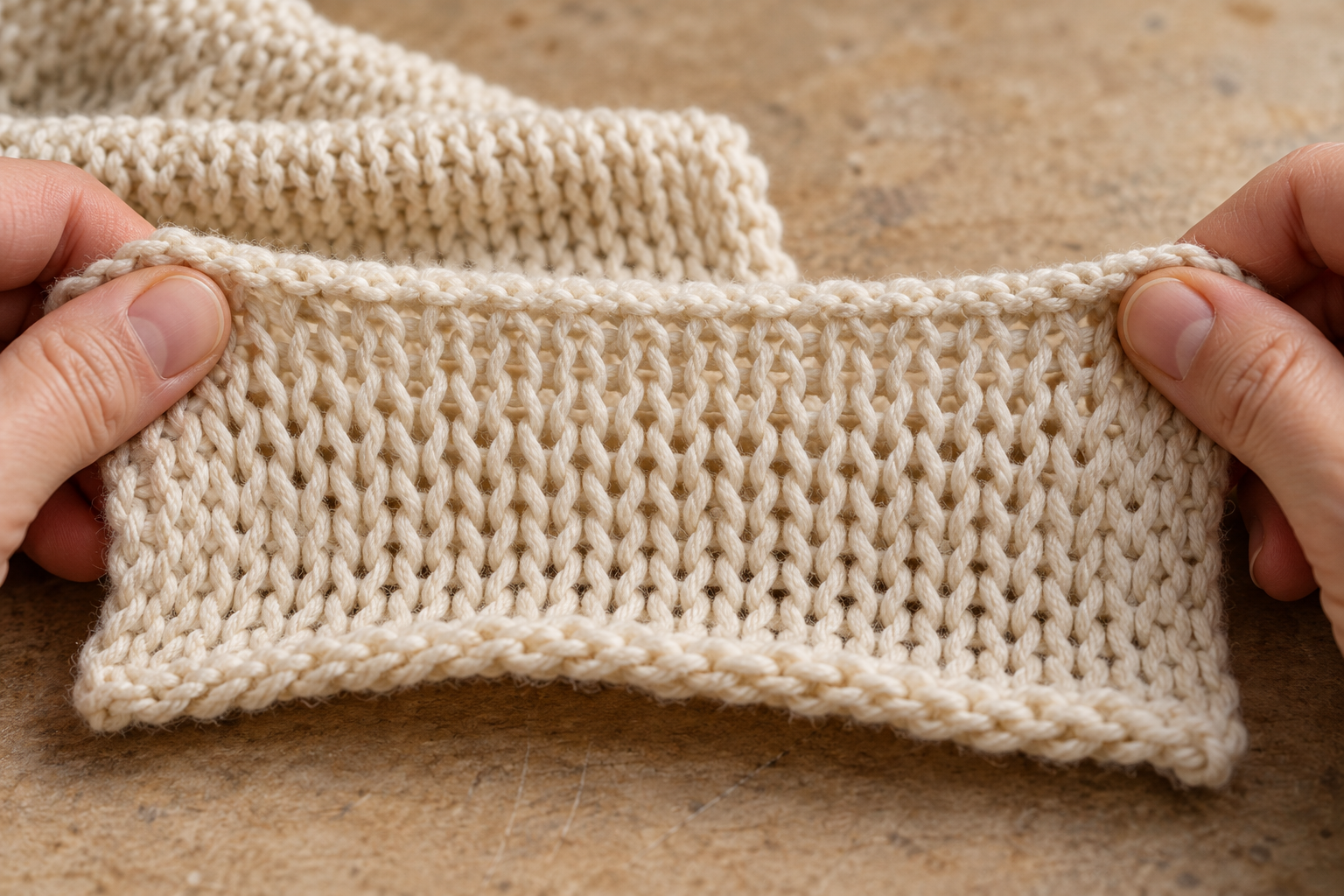
Take the edge of a knitted cuff between two hands and draw it gently sideways. The holes between the stitches widen. The columns of loops lean and change shape. The fabric has become longer in the direction of the pull, although no one had to manufacture a longer strand of yarn. Much of the first stretch of a knit is a change in the route that yarn takes through the cloth.
That distinction is the useful starting point. A straight yarn and a fabric made from the same yarn need not respond alike to the same pull. In a knit, the yarn travels around curved loops and through neighboring loops. Pulling can bend those curves, rotate them, move yarn between adjacent stitches and alter where strands touch. The material has room to rearrange before the yarn itself must lengthen much. In a 2018 experiment and model of stockinette fabric, researchers measured the changing positions of individual stitches as they pulled a nylon knit. Their model reproduced the fabric's response by treating yarn bending, nearly conserved yarn length and the way loops interlock as central ingredients. That is a carefully studied stockinette swatch, not a claim that yarn extension is negligible in every knitted cloth.
The path of a loop also makes a knit more than a sheet with one number called “stretch.” A column of stitches is a wale; a row crossing it is a course. Pull across the courses and the loops open sideways. Pull along the wales and a different collection of bends and contacts must move. The force needed, the amount of length gained and the route back can differ in the two directions. Textile engineers call that directional behavior anisotropy. It is visible in everyday cloth, but its size belongs to a particular stitch, yarn and test, not to knitting as an entire category.
Where the extra length comes from
The order in which the cloth yields matters. Early in a pull, slack and curved portions of yarn can change shape with relatively little force. As the loops reorient and their contacts tighten, gaining further length can require more force. If the structure is driven far enough, yarn stretch and damage become increasingly relevant. The 2018 stockinette tests found a region of low stiffness followed by a region that stiffened under increasing extension. The authors tracked stitch centers as well as the overall force, so the conclusion rests on observed motion within that one fabric. Their measurements also show why a single percentage measured at one load tells only part of the story.
Stitch pattern changes the available motions. Knit and purl stitches use a similar loop viewed from opposite sides, yet their arrangement changes how neighboring loops join. In a 2024 study of stockinette, garter, rib and seed fabrics, researchers combined tensile tests with yarn-level simulations. They found that the connecting pieces of yarn between unlike neighboring stitches could rotate in a way that made a direction easier to extend; connections between like stitches responded differently. Rib and garter samples each mixed those connections, producing directional differences. The study's strength is that it compares patterns made under controlled conditions. Its lesson is not that one named stitch will always have the same stretch in every yarn and gauge; it is that the arrangement of loops can alter the mechanical response even when the yarn is held constant.
The amount of yarn assigned to each loop matters as well, though “longer loop” is not a universal answer to “more stretch.” More loop length changes the initial spacing, contact and slack available to the fabric. A 2023 experimental study varied yarn composition, loop length and the number of float stitches in machine-knitted fabrics, then measured tensile behavior in wale and course directions. Those variables interacted in the tested structures. A float is a strand carried across stitches rather than drawn into every loop; it can limit some movements even while other parts of a fabric yield. The study examined knits intended for textile composites, so its results should not be copied as a clothing-size formula. It makes the more modest point that direction, loop length, yarn and float placement have to be considered together.
There is a related warning in a 2024 experiment on compression-stocking materials. The researchers compared plain and rib structures at different stitch lengths after washing, measuring stretch and recovery across the stockings. In their tested set, a 2 × 2 rib gave the greatest stretch, while a 1 × 3 rib with connecting floats gave the least. The two structures share the word rib but not the same path for yarn to move. Stocking yarns contained polyamide and elastane, and the tests were designed for that product. They show how a familiar stitch label can conceal construction details that matter to the hand and to the tensile machine.
Stretch is not the same as return
Release the cuff, and another property comes into view. Some of the shape change is recoverable: bent yarn and stretched fibres can pull the loops toward earlier positions. But the return journey may not retrace the outward one. Yarn rubs where strands cross or slide. In the 2018 stockinette experiment, the fabric returned to its initial shape over repeated cycles even though the force on release differed from the force used to extend it. The gap between those loading and unloading curves is called hysteresis: some work was dissipated rather than stored and returned. The authors attributed much of that gap to friction within their knit. Hysteresis in that test did not by itself mean permanent growth.
Other constructions do retain length after a pull. A recovery test therefore asks two questions: how far did the fabric extend under a stated force, and how close did it come back after a stated interval? The answers can change with the number of pulls. In a 2022 study of plated weft knits, researchers made fabrics from polyamide with different amounts and forms of elastane, then measured loading and unloading in both wale and course directions. In those samples, elastane percentage significantly changed the range of recoverable elastic deformation, while it did not significantly change the study's hysteresis index. That pairing is instructive. An elastic fibre can widen the useful stretch-and-return range without making every aspect of a fabric's response vary in the same way.
The yarn itself is not passive. A yarn's resistance to bending, its ability to extend and recover, and the friction among its fibres and at its crossings all affect what the loops can do. Nor do all knitting methods arrange yarn alike. In experiments on a particular polyester warp-knit tricot, investigators treated the start of yarn slippage and sliding friction as important to large deformations. That work concerns a warp-knit structure, not the weft-knit cuff at the start of this piece; it underlines why a single loop sketch cannot predict all fabrics. A stiff yarn in loose loops, a compliant yarn in tight loops and an elastic yarn held by long floats can feel different for different reasons.
The difference matters when judging a garment. A swatch that opens easily in one direction may resist the other; a lively first stretch may leave some growth after repeated use. A knit meant to fit around a moving body also has edges and joins that may constrain the fabric, so the cloth's behavior cannot be read from fibre content alone. A useful comparison names the stitch structure, the direction of the pull, the load or extension, and when recovery was measured. Hand feel still tells us something valuable, but a claim about “stretch” becomes clearer when it says which of those questions it answers.
Look again at the cuff after the hands let go. Its loops have not merely acted like tiny rubber bands. They have bent, shifted and pressed against one another along a route set by the maker. The fabric's length comes from that route; its return depends on how much of the journey the yarn and its contacts can reverse.
A thought worth keeping?