A cotton thread can be far longer than any cotton fiber inside it. The fibers overlap, and the thread survives a pull because they resist sliding past one another. Twist helps them do that. It wraps the fibers into a narrower bundle and presses them together. Yet a fiber that winds around the thread also points less directly along the pull. A strong spun yarn has to settle that conflict: enough grip to keep its fibers in place, enough lengthwise alignment for them to carry the load.
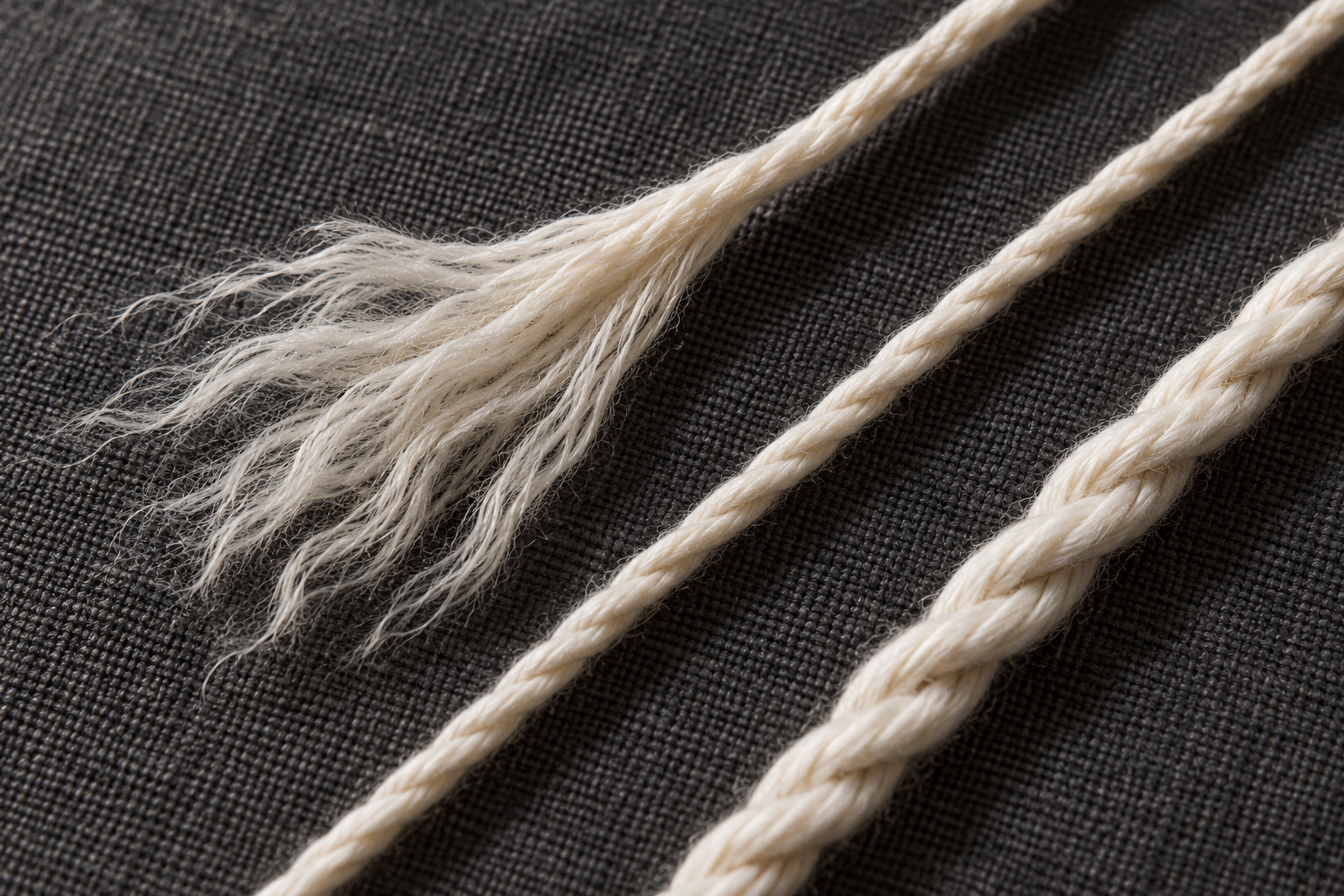
The low-twist end of the problem can be seen by taking twist away. In an untwisting and drafting experiment with spun polyester and acrylic yarns, researchers found a range in which a yarn failed because its fibers slipped rather than broke. Their measured range varied with fiber dimensions and the arrangement of fibers in the yarn. It gives a physical meaning to the familiar impression that a loose strand can pull apart: the individual fibers may still be intact, but the bundle no longer holds them firmly enough.
Adding twist first helps. The fibers press against their neighbors, creating more resistance to sliding. In a 1935 National Bureau of Standards study of cotton yarns, the researchers described this as radial pressure: twist reduced the bundle's diameter and brought its fibers into closer contact. They spun one fine and one coarse yarn at many twist levels, then measured strength, elongation, diameter, and fiber angle. The strength rose as moderate twist gave the fibers a better grip.
Where another turn stops helping
Grip is only half the strength test. As twist grows, the outer fibers follow a steeper helix around the yarn. More of their length lies at an angle to the force pulling on the thread. The 1935 researchers also noted internal stresses from twisting and uneven load sharing: fibers near the yarn's surface did not carry a pull in the same way as fibers near its axis. At high twist, those disadvantages outweighed the small extra gain in friction. Tensile strength fell. A 1960 theoretical study of single staple yarns twisted beyond their optimum likewise treated the fibers' inclination and the yarn's contraction as part of what limits strength beyond the peak. The model describes a particular idealized yarn, not a number to dial into every spinning wheel.
The earlier experiments already showed why that number would be elusive. In 1928, Bureau of Standards researchers spun combed and carded cotton yarns at different twist levels. Their strength curves climbed and then declined as twist was added. For the same tested yarns, however, the apparent peak came at a twist multiplier of about 4.25 when strength was measured by breaking a skein and about 5.25 when individual strands were broken. The later Bureau study also found that multiple-strand and skein tests tended to place the peak slightly below the single-strand test. “Strongest” needs a test method as well as a yarn description.
Those figures are twist multipliers, not turns per inch. In the cotton-count convention used in the 1935 work, turns per inch equal the multiplier times the square root of the yarn's cotton count. A finer cotton-count yarn can therefore have more turns per inch at the same multiplier. Fiber length, count, preparation, and the way the yarn is tested also shift the result. Copying one historical multiplier into a different yarn would hide the very variables the experiments were designed to measure.
The letters S and Z describe the direction in which the twist slopes. They are useful for specifying how a yarn is made, especially when strands are later combined; they are not labels for weak and strong. The 1935 study spun its cotton test yarns in both directions. For the coarser yarn, it found no consistent difference in the results attributable to right-hand versus left-hand twist across the tested multipliers. The direction belongs in the yarn's description, but it cannot replace a strength measurement.
A second twist when strands are plied
Plying brings two or more already spun singles together and twists them into a new yarn. Now the maker chooses both the twist in each single and the twist that binds the singles. In a 1954 test of a two-ply carded cotton yarn, the highest ply strength came from relatively low-twist singles given a high ply twist in the tested range. When the researchers used the same multiplier for the singles and the ply, the multiplier that made the singles strongest also made the ply strongest. Both findings belong to that cotton construction; together they show why the strongest single is not automatically the only route to the strongest two-ply thread.
A 2005 study of cotton two-ply yarns and multifilament plies found that changing the twist of the cotton singles improved ply tensile strength faster than changing the ply twist ratio under its conditions. In its finer multifilament yarns, changing the ply-to-single or cable-to-ply twist ratio made little difference to tensile strength. The extra structural choice matters, but its effect depends on what the strands themselves are made of.
A continuous-filament yarn starts from a different premise. Its filaments extend along the yarn, so it does not need twist chiefly to keep short staple fibers from slipping free. Tests of several high-performance continuous polymer yarns found that a little twist could improve tensile strength, while a high degree damaged fibers and reduced it. Stiffness at the start of stretching fell steadily as twist increased. The same turning motion changes more than one property, and the mechanism is not identical to that of cotton staples.
Even for a single material, maximum tensile strength need not be the best thread for every cloth. The 1928 researchers discussed toweling, where softness and absorbency could justify less twist and some loss of strength, provided the yarn still endured laundering. A thread's twist is therefore a choice about use as well as a peak on a breaking-strength curve. The most useful turn is the one that lets the fibers hold together while leaving enough of their strength pointed along the work the thread must do.
A thought worth keeping?