A wool sweater can leave a wash with a shorter hem, a denser hand, or a shoulder that simply sits differently. These changes look alike when you hold the garment up. They need not have the same cause. Water can alter the shape of a fiber while it is wet; it can let a fabric release strain held since manufacture; and, with enough movement, it can help loose fibers work into a felted mass. The difference matters because one change may reverse as the cloth dries, while another will remain.
The fiber swells; the fabric decides where to move
Wool takes up moisture. Its fibers swell more across their width than along their length, but a garment is not a row of straight fibers. Each fiber bends within a yarn; each yarn bends through a knit loop or over and under another yarn in a weave. A small change at fiber scale can therefore appear as a change in the length, width, or drape of the whole cloth.
In a study of Merino and Corriedale wool, Qing Li and colleagues measured fiber diameters in water at different pH levels. The fibers' swelling varied with the solution, and the fabric dimensions varied too. The result is a useful warning against a simple picture of water making every wool item uniformly smaller. The experiment concerns controlled wet treatments; its pH findings are not a household recipe for restoring a sweater.
The arrangement of the yarns changes the answer. K. Baird studied ten worsted fabrics and described hygral expansion: a reversible dimensional response to changing moisture. The bending and straightening of arcs within the fibers helped explain how the yarns moved. Radial swelling alone could not explain the fabric's behavior. A woven sleeve may pucker when damp and settle again as it dries, though whether a particular sleeve does so depends on its construction and finishing.
Moisture in the air can be enough to shift dimensions. In a study of eleven historic wool and silk textiles and two modern canvases, researchers found that cloth first expanded as relative humidity rose from dry conditions, then contracted to varying degrees at higher humidity. Yarn crimp and weave geometry shaped the response. Those measurements were made in changing air humidity, not in a wash basin. They show how much of a textile's apparent movement belongs to the arrangement of its yarns.
The first wetting can release old tension
Some dimensional change lasts after the fabric has dried. During manufacture, cloth can be stretched or held under tension. Wetting may allow part of that stored strain to relax, taking the fabric toward a size it would have chosen without the pull. Textile engineers call this relaxation shrinkage. It is distinct from a transient change while the fiber is swollen, and it does not require the fibers to mat together.
Baird's measurements of seven worsted fabric structures from five mills found different amounts of warp relaxation shrinkage across mills and constructions. Fabrics that extended more under loads typical of finishing machines also showed more relaxation shrinkage in that direction. The result is about those tested worsteds, yet the principle is broader: the condition in which a garment was made helps determine what water can release.
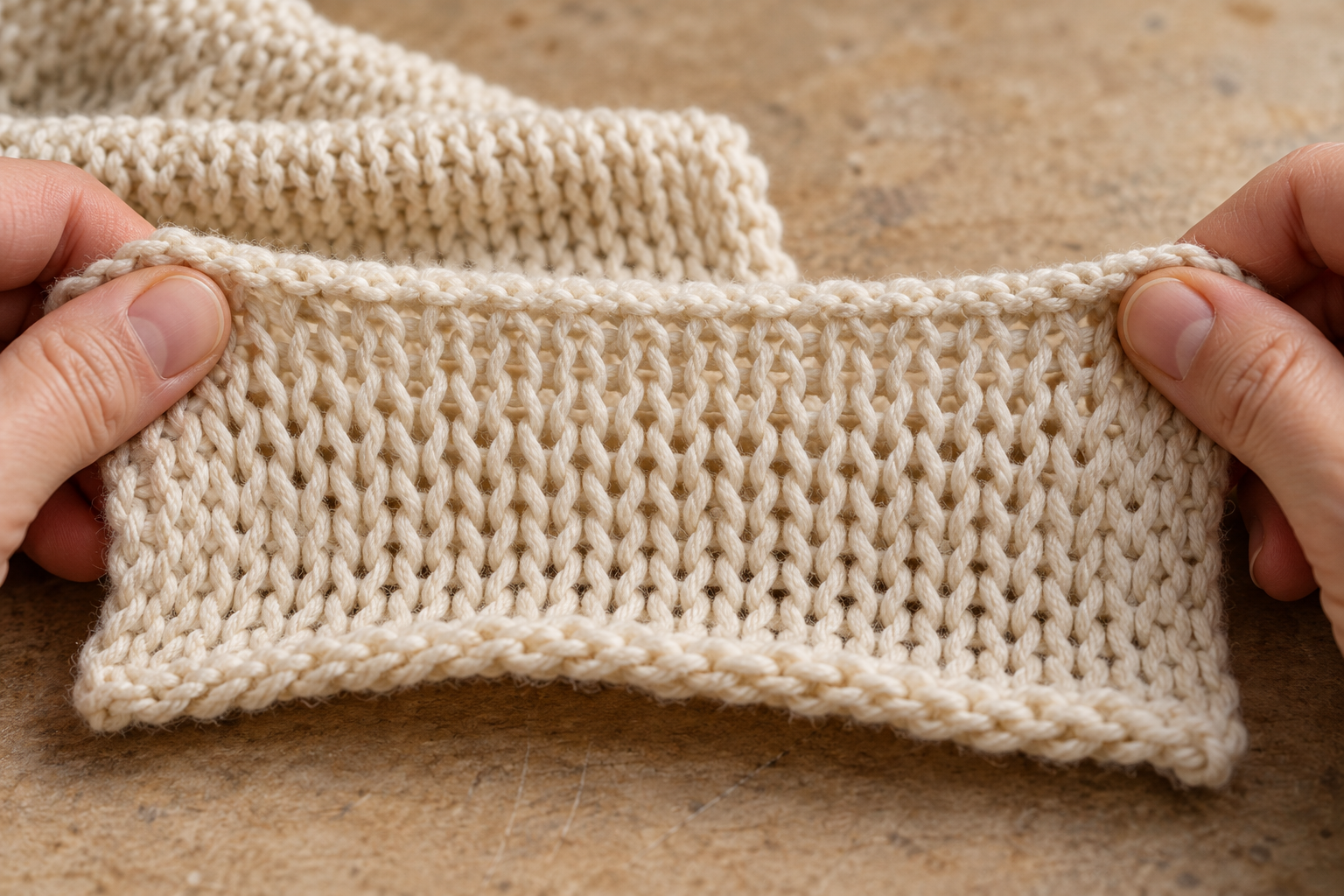
Knits add another layer. A sweater is built from loops that can shift toward a less strained shape. In tests of rib and half-cardigan wool knits, J. J. F. Knapton and W. Fong separated, approximately, the change from relaxation from later change caused by felting. Their work makes an important point about a sweater that seems smaller after its first wash: a shorter hem alone does not identify felting. You would need to know whether the loops merely settled, whether fibers migrated, or whether both occurred.
Movement can make the change harder to undo
An individual wool fiber has overlapping scales on its surface. Daniel Frishman, Arthur Smith, and Milton Harris measured the friction of individual wool fibers and found that rubbing in one direction met more resistance than rubbing in the other. In their tests, wet fibers also showed greater friction than the same fibers dry. Under repeated mechanical action, this directional difference helps fibers migrate through a yarn and tangle with neighbors. The result can be a thicker, denser fabric with less area: felting shrinkage.
The scales are sometimes pictured as tiny hooks. That image leaves out the fabric around them. Felting depends on how fibers move within yarns and how yarns sit in a cloth, as well as on the fiber surface. In Knapton and Fong's rib-knit tests, untreated samples felted during machine washing even after the researchers had brought them close to a fully relaxed state. Felting rates depended strongly on how tightly the fabric was knitted. A loose or tight knit cannot be predicted from the word wool on its label alone.
Washing method matters, too. Christopher Hurren, Peter Cookson, and Xungai Wang compared ultrasonic laundering with hand washing in their tested wool fabrics. Ultrasonic agitation produced less fiber migration, thickness increase, and felting than the hand-washing condition they used. That is a comparison of specific methods, not proof that any one home routine is safe for every garment. It does, however, show why the amount and kind of movement belongs in the explanation alongside water.
Read the garment's history, then its label
Two sweaters made from wool may behave differently because one yarn was treated to resist felting, one fabric was already relaxed during finishing, or their loops were knitted to different dimensions. The Woolmark Company's 2018 sweater-care guide begins with the care label for that reason. It distinguishes dry-clean-only, hand-wash, machine-washable, and tumble-dry claims. For a garment labeled machine washable, it recommends a wool or delicate cycle and flat drying; for hand washing, it cautions against excessive squeezing and wringing. The claim belongs to the garment, not to wool as a species of fiber.
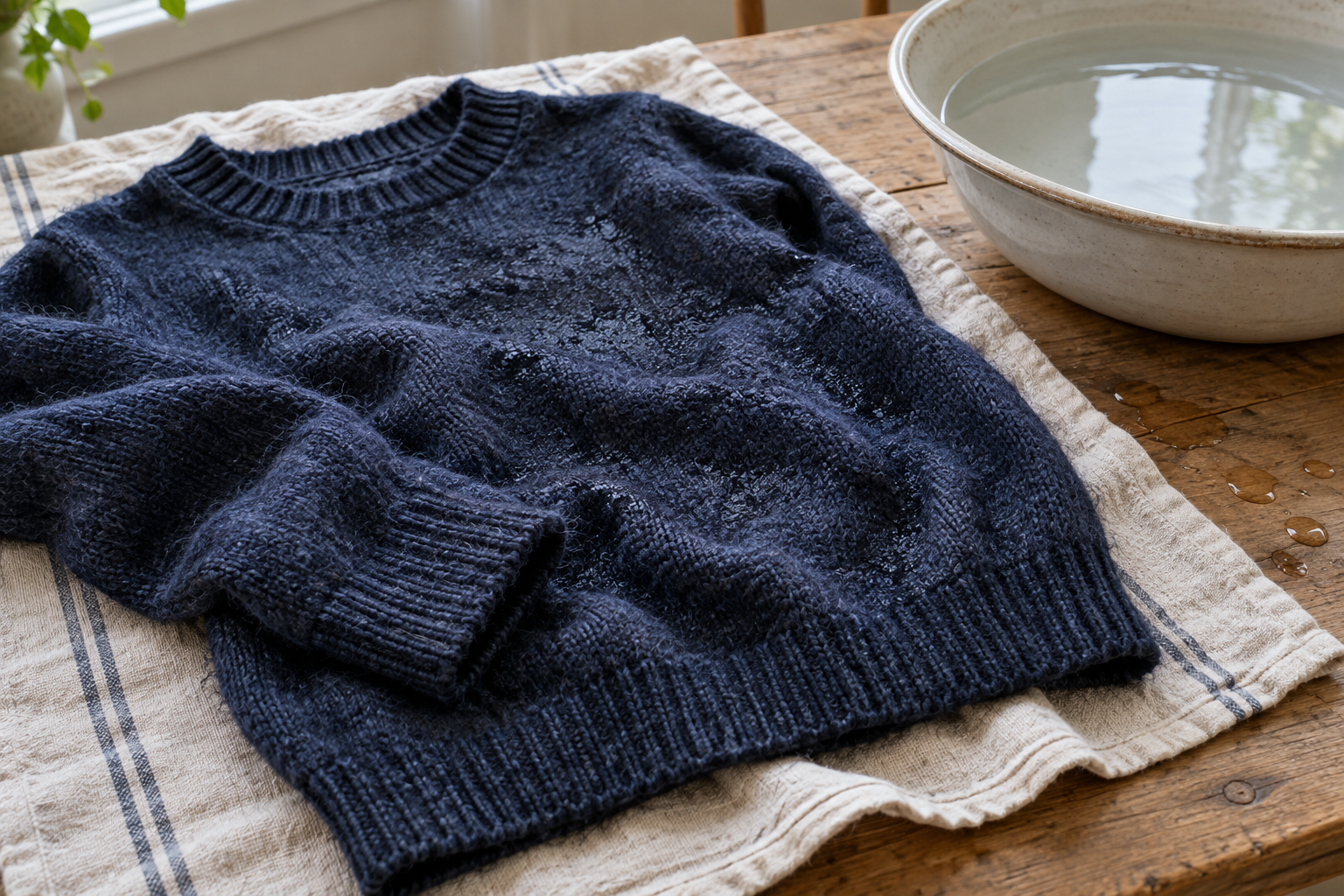
After washing, a wet sweater laid flat may still look larger in one direction or shorter in another. Give it the drying conditions its label calls for before deciding what has changed. A temporary shift in yarn geometry may pass. A released manufacturing strain or felted network may not. The cloth carries a record of how it was spun, knitted, woven, finished, and washed; water makes parts of that record visible.
A thought worth keeping?